
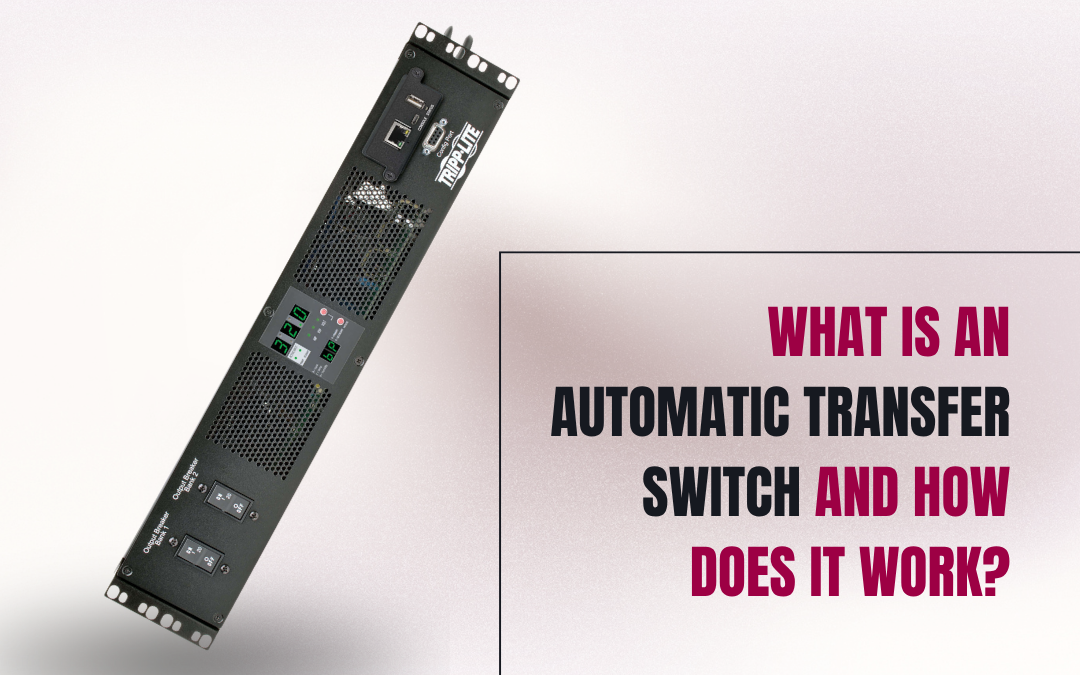
Power interruptions can affect everything from computer networks and telecommunications equipment to industrial systems and critical infrastructure. Where electrical equipment depends on more than one available power source, an automatic transfer switch (ATS) can provide an important part of the power-transfer system.
But what exactly is an automatic transfer switch, how does it work, and when is an ATS needed?
An automatic transfer switch is an electrical switching device designed to automatically transfer a connected load between a primary power source and an alternate power source when the primary supply becomes unavailable or falls outside configured operating conditions. Depending on the installation, the alternate source may be a generator, UPS system or another utility supply.
What Is an Automatic Transfer Switch?
An automatic transfer switch, commonly known as an ATS, monitors two available power sources and controls which source supplies the connected electrical load.
Under normal conditions, the load is supplied by the preferred or primary source. If the ATS detects a problem with that source, its control system can initiate a transfer to the alternate source, provided the alternate supply is available and within the required operating conditions.
When the primary source returns to an acceptable condition, the ATS can transfer the load back according to its configured sequence.
In simple terms:
Primary Power → ATS → Electrical Load
If the primary source becomes unavailable:
Alternate Power → ATS → Electrical Load
This makes an ATS particularly useful in applications where maintaining access to electrical power is important.
How Does an Automatic Transfer Switch Work?
An ATS uses control logic to monitor the available power sources. Modern systems can monitor electrical characteristics such as voltage and frequency to determine whether a source is suitable for supplying the connected load.
A typical automatic transfer sequence involves several stages.
1. The primary power source supplies the load
Under normal operating conditions, the preferred power source supplies the connected equipment.
The ATS continuously monitors the system according to its configured settings.
2. The ATS detects a power problem
If the primary source fails or moves outside its acceptable operating range, the ATS detects the abnormal condition.
The specific detection criteria depend on the equipment and its configuration.
3. The alternate source becomes available
The alternate source may be a standby generator, backup utility supply or another suitable power source.
For generator applications, the transfer occurs when the alternate source has reached the required operating conditions.
4. The ATS transfers the load
The ATS changes the connection so that the load is supplied by the alternate source.
The actual transfer characteristics depend on the ATS design, electrical system and configuration.
5. Primary power is restored
When the primary source returns to acceptable conditions, the ATS can transfer the load back to the preferred source according to its programmed sequence.
This automatic process reduces the need for someone to manually operate the switch during every power event.
Why Is an Automatic Transfer Switch Important?
An ATS can form an important part of a power redundancy strategy.
If the preferred source becomes unavailable, an appropriately designed ATS can transfer the load to the alternate source.
This type of arrangement is commonly used in environments such as data centres, hospitals, factories, telecommunications facilities and other sites where power availability is important.
However, an ATS does not create backup power by itself. It transfers the load between available sources. The overall system still depends on the capacity, availability and correct configuration of the primary and alternate power sources.
Can an Automatic Transfer Switch Work With a UPS?
Yes, an ATS can be used as part of a power system that includes uninterruptible power supply (UPS) equipment.
However, an ATS and UPS have different functions.
A UPS provides backup power and, depending on its design, power conditioning and battery-supported operation.
An ATS transfers a load between available power sources.
For example, an ATS/PDU designed for IT equipment may provide two input power sources and automatically select an available source for connected equipment. Rack-mounted ATS products are commonly used to provide redundant power arrangements for networking and server equipment.
Therefore, an ATS should not be considered a replacement for a UPS. They can perform complementary roles within a properly designed power system.
What Are the Different Types of Automatic Transfer Switches?
Automatic transfer switches are available in different configurations to suit different applications.
1. Rack-Mount ATS
Rack-mounted ATS units are designed for applications such as servers, networking equipment and other rack-mounted technology. Some models combine automatic transfer switching with power distribution units and monitoring functions.
2. Generator ATS
These systems are designed to transfer loads between normal utility power and standby generator power.
3. Utility-to-Utility ATS
Some systems transfer a load between two utility or other independent power sources.
4. Bypass-Isolation ATS
Bypass-isolation designs provide a way to isolate the main transfer mechanism for inspection, testing or maintenance while maintaining an alternate supply path, depending on the system configuration.
5. Open, Closed and Delayed Transition ATS
Transfer switches can also be designed with different transition methods. Schneider Electric’s Australian range, for example, includes open-transition, closed-transition and delayed-transition configurations for applicable systems.
The appropriate configuration depends on the electrical system, connected load and required transfer characteristics.
Where Are Automatic Transfer Switches Used?
Automatic transfer switches can be used across a wide range of commercial and industrial environments, including:
- Data centres
- Server rooms
- Telecommunications facilities
- Healthcare facilities
- Manufacturing sites
- Commercial buildings
- Industrial facilities
- Critical infrastructure
- Network environments
- Backup power systems
The correct ATS depends on the electrical characteristics and operational requirements of the application.
How Do You Choose an Automatic Transfer Switch?
Selecting an ATS involves more than simply matching the product name to the application.
Consider the following:
1. Voltage
Confirm that the ATS is suitable for the voltage of the electrical system.
2. Current rating
The switch needs to be appropriately rated for the connected load.
3. Single-phase or three-phase
Determine the phase configuration required by the installation.
4. Number of poles
The number of poles should match the electrical system and installation requirements.
5. Transfer characteristics
Consider how quickly and under what conditions the load needs to transfer between sources.
6. Power sources
Identify whether the ATS will transfer between utility and generator, two utility sources, UPS systems or another configuration.
7. Installation requirements
Rack-mounted IT applications may have very different requirements from larger commercial or industrial installations.
8. Monitoring and control
Some ATS products offer monitoring, metering and network-management capabilities. These features can be particularly useful for managed IT and critical-power environments.
Always check the manufacturer’s specifications and have electrical equipment selected and installed in accordance with applicable requirements.
Automatic Transfer Switch vs Manual Transfer Switch
The main difference is how the transfer operation is initiated.
A manual transfer switch requires an operator to change the power source.
An automatic transfer switch uses its control system to initiate the transfer when configured conditions are detected.
This distinction makes automatic transfer particularly useful where rapid response or reduced manual intervention is important. Schneider Electric describes automatic transfer switches as systems that can switch loads to emergency power without human interaction during an outage.
Frequently Asked Questions About ATS
1. What does an automatic transfer switch do?
An automatic transfer switch transfers an electrical load between a primary and alternate power source when the configured conditions for transfer are met.
2. Does an ATS provide backup power?
No. An ATS transfers power between available sources. A generator, UPS or alternate utility supply must provide the backup or secondary source.
3. Can an ATS work without a generator?
Yes. Depending on the ATS and system configuration, the alternate source can be another utility supply, UPS or other suitable power source.
4. Is an ATS the same as an automatic changeover switch?
The terms can be used to describe similar automatic source-switching equipment. The exact terminology varies by product and application.
5. How fast does an automatic transfer switch operate?
Transfer time varies significantly by product, configuration and application. Always check the manufacturer’s technical specifications rather than assuming a particular transfer time.
5. Is an ATS required for every backup power system?
Not necessarily. Whether an ATS is appropriate depends on the power architecture, equipment requirements, backup source and intended operating sequence.
Conclusion
An automatic transfer switch (ATS) is a key component in many redundant and backup power systems. By monitoring available power sources and automatically transferring a connected load when configured conditions are met, an ATS can help support power availability for critical equipment.
Whether you are considering an ATS for a generator, UPS, server room, network environment or other critical application, selecting the correct voltage, current rating, phase, transfer configuration and installation type is essential.
For businesses looking for automatic transfer switch solutions in Australia, Source22 provides ATS and ATS/PDU products for applications requiring automated power-source transfer and power redundancy.
Need help selecting an automatic transfer switch? Explore Source22’s automatic transfer switch range or contact the team to discuss your application and power requirements.
